what name is sometimes used to refer to the entire set of d-block elements

Blocks s, f, d, and p in the periodic table
A block of the periodic table is a set of elements unified by the atomic orbitals their valence electrons or vacancies prevarication in.[1] The term appears to have been get-go used by Charles Janet.[two] Each block is named after its characteristic orbital: s-block, p-block, d-block, and f-cake.
The block names (due south, p, d, and f) are derived from the spectroscopic note for the value of an electron'due south azimuthal breakthrough number: precipitous (0), principal (one), lengthened (two), or cardinal (three). Succeeding notations proceed in alphabetical order, as k, h, etc., though elements that would belong in such blocks accept not yet been institute.
Characteristics [edit]
The sectionalization into blocks is justified by their distinctive nature: s is characterized, except in H and He, past highly electropositive metals; p by a range of very distinctive metals and non-metals, many of them essential to life; d by metals with multiple oxidation states; f by metals and so similar that their separation is problematic. Useful statements almost the elements can be made on the basis of the cake they belong to and their position in it, for instance highest oxidation state, density, melting betoken… Electronegativity is rather systematically distributed across and between blocks.
PJ Stewart
In Foundations of Chemical science, 2017[iii]
There is an approximate correspondence between this nomenclature of blocks, based on electronic configuration, and sets of elements based on chemical backdrop. The south-block and p-block together are unremarkably considered main-group elements, the d-block corresponds to the transition metals, and the f-block encompasses well-nigh all of the lanthanides (similar lanthanum) and the actinides (like actinium). Not everyone agrees on the exact membership of each set of elements. For case, the group 12 elements zinc, cadmium, and mercury are often regarded as main group, rather than transition group, because they are chemically and physically more than similar to the p-block elements than the other d-block elements. The grouping 3 elements are sometimes considered main group elements due to their similarities to the southward-block elements. Groups (columns) in the f-block (between groups 2 and 3) are not numbered.
Helium is an s-block element, with its outer (and only) electrons in the 1s diminutive orbital, although its chemical properties are more than like to the p-block noble gases in grouping 18 due to its full shell.
s-block [edit]
…Na, K, Mg and Ca are essential in biological systems. Some…other due south-block elements are used in medicine (e.g. Li and Ba) and/or occur as minor but useful contaminants in Ca bio-minerals east.grand. Sr…These metals display simply one stable oxidation country [+1 or +2]. This enables [their]…ions to motility around the cell without…danger of being oxidised or reduced.
Wilkins RG and Wilkins PC (2003)
The part of calcium and comparable cations in animal behaviour, RSC, Cambridge, p. ane
The s-cake is on the left side of the conventional periodic table and is composed of elements from the get-go two columns plus one chemical element in the rightmost column, the nonmetals hydrogen and helium and the alkali metals (in group 1) and alkaline earth metals (group 2). Their general valence configuration is ns1–2. Helium is an s-chemical element, simply most always finds its place to the far right in group 18, above the p-element neon. Each row of the table has two southward-elements.
The metals of the southward-block (from the second period onwards) are more often than not soft and accept generally low melting and boiling points. Well-nigh impart color to a flame.
Chemically, all s-elements except helium are highly reactive. Metals of the south-block are highly electropositive and often class substantially ionic compounds with nonmetals, peculiarly with the highly electronegative element of group vii nonmetals.
p-cake [edit]
The p-cake is on the right side of the standard periodic tabular array and encompasses elements in groups 13 to eighteen. Their general electronic configuration is nsouthward2 northwardp1–6. Helium, though being the beginning element in group xviii, is non included in the p-cake. Each row of the tabular array has a identify for half-dozen p-elements except for the get-go row (which has none).

Aluminium (metal), diminutive number 13

Silicon (metalloid), diminutive number xiv
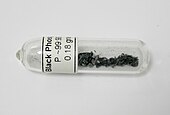
Phosphorus (nonmetal), atomic number 15
This block is the simply one having all three types of elements: metals, nonmetals, and metalloids. The p-block elements can exist described on a grouping-past-group ground as: group 13, the icosagens; xiv, the crystallogens; 15, the pnictogens; xvi, the chalcogens; 17, the halogens; and 18, the helium group, equanimous of the noble gases (excluding helium) and oganesson. Alternatively, the p-block can be described as containing post-transition metals; metalloids; reactive nonmetals including the halogens; and noble gases (excluding helium).
The p-block elements are unified by the fact that their valence (outermost) electrons are in the p orbital. The p orbital consists of six lobed shapes coming from a central signal at evenly spaced angles. The p orbital tin concord a maximum of vi electrons, hence there are half-dozen columns in the p-cake. Elements in column thirteen, the first column of the p-block, have one p-orbital electron. Elements in cavalcade fourteen, the second column of the p-block, have 2 p-orbital electrons. The trend continues this way until column eighteen, which has 6 p-orbital electrons.
The cake is a stronghold of the octet dominion in its first row, but elements in subsequent rows often display hypervalence. The p-block elements evidence variable oxidation states ordinarily differing by multiples of 2. The reactivity of elements in a group generally decreases down. (Helium breaks this trend in grouping 18 past being more reactive than neon, but since helium is actually an s-block element, the p-block portion of the trend remains intact.)
Oxygen and the halogens tend to class more ionic compounds with metals; the remaining reactive nonmetals tend to form more covalent compounds, although ionicity is possible when the electronegativity difference is high plenty (eastward.one thousand. Li3Due north). The metalloids tend to course either covalent compounds or alloys with metals.
d-block [edit]
The... elements show a horizontal similarity in their physical and chemical properties too as the usual vertical relationship. This horizontal similarity is so marked that the chemistry of the first... serial... is often discussed separately from that of the 2nd and third serial, which are more like to one another than to the first series.
Kneen WR, Rogers MJW, and Simpson P 1972
Chemistry: Facts, patterns, and principles, Addison-Wesley, London, pp. 487−489
The d-block is in the heart of the periodic tabular array and encompasses elements from groups 3 to 12; information technology starts in the 4th period. Periods from the fourth onwards have a infinite for ten d-block elements. Nigh or all of these elements are besides known every bit transition metals because they occupy a transitional zone in properties, between the strongly electropositive metals of groups 1 and 2, and the weakly electropositive metals of groups 13 to 16. Group iii or group 12, while yet counted equally d-block metals, are sometimes not counted as transition metals considering they do not show the chemical properties characteristic of transition metals, for example, multiple oxidation states and coloured compounds.
The d-block elements are all metals and most have i or more chemically active d-orbital electrons. Because in that location is a relatively small divergence in the energy of the different d-orbital electrons, the number of electrons participating in chemical bonding tin can vary. The d-block elements accept a tendency to exhibit 2 or more oxidation states, differing by multiples of one. The most common oxidation states are +ii and +3. Chromium, atomic number 26, molybdenum, ruthenium, tungsten, and osmium can have formal oxidation numbers every bit low as −four; iridium holds the atypical distinction of being capable of achieving an oxidation state of +ix.
The d-orbitals (four shaped every bit iv-leaf clovers, and the fifth equally a dumbbell with a ring around it) tin can contain upward to five pairs of electrons.
f-cake [edit]
Considering of their complex electronic structure, the significant electron correlation effects, and the large relativistic contributions, the f-block elements are probably the almost challenging group of elements for electronic structure theory.
Dolg M 2015 (ed.)
Computational methods in lanthanide and actinide chemical science, John Wiley & Sons, Chichester, p. xvii
Periods from the sixth onwards have a place for 14 f-block elements. The f-block appears as a footnote in a standard eighteen-column table but is located at the center-left of a 32-column full width table. While these elements are more often than not not considered part of whatever group, some authors consider them to be part of group iii. They are sometimes called inner transition metals considering they provide a transition betwixt the south-block and d-block in the 6th and seventh row (menstruation), in the same way that the d-block transition metals provide a transitional bridge betwixt the southward-cake and p-cake in the 4th and 5th rows.
The f-block elements come in ii series, in periods 6 and vii. All are metals. The f-orbital electrons are less active in the chemistry of the menstruation 6 f-block elements, although they do make some contribution:[4] these are rather like to each other. They are more than active in the early on period 7 f-block elements, where the energies of the 5f, 7s, and 6d shells are quite similar; consequently these elements tend to show as much chemical variability as their transition metals analogues. The later f-block elements deport more than like their menses 6 counterparts.
The f-block elements are unified by by and large having one or more than electrons in an inner f-orbital. Of the f-orbitals, six have six lobes each, and the seventh looks like a dumbbell with a donut with two rings. They tin contain up to seven pairs of electrons hence the block occupies fourteen columns in the periodic table. They are non assigned group numbers, since vertical periodic trends cannot be discerned in a "group" of two elements.
The 2 14-member rows of the f-block elements are sometimes confused with the lanthanides and the actinides, which are names for sets of elements based on chemical backdrop more than so than electron configurations. The lanthanides are the 15 elements running from lanthanum (La) to lutetium (Lu); the actinides are the 15 elements running from actinium (Ac) to lawrencium (Lr).
g-block [edit]
A yard-cake is predicted to begin in the vicinity of element 121. Though yard-orbitals are not expected to starting time filling in the basis state until around element 124–126 (see extended periodic table), they are likely already low plenty in energy to start participating chemically in element 121,[5] similar to the situation of the 4f and 5f orbitals.
If the trend of the previous rows continued, then the g-block would have 18 elements. However, calculations predict a very strong blurring of periodicity in the eighth period, to the point that individual blocks get hard to delineate. It is likely that the eighth menstruum will not quite follow the trend of previous rows.[vi]
Symmetry [edit]
The four blocks can be rearranged such that they fit, equidistantly spaced, inside a regular tetrahedron.[vii] [ clarification needed ]
Run into also [edit]
- Electron shell subshells
References [edit]
- ^ Jensen, William B. (21 March 2015). "The positions of lanthanum (actinium) and lutetium (lawrencium) in the periodic table: an update". Foundations of Chemical science. 17: 23–31. doi:x.1007/s10698-015-9216-1. S2CID 98624395.
- ^ Charles Janet, La classification hélicoïdale des éléments chimiques, Beauvais, 1928
- ^ Stewart, P. J. (7 November 2017). "Tetrahedral and spherical representations of the periodic organization". Foundations of Chemistry. xx (two): 111–120. doi:10.1007/s10698-017-9299-y.
- ^ Gschneidner Jr., Karl A. (2016). "282. Systematics". In Jean-Claude Thousand. Bünzli; Vitalij Yard. Pecharsky (eds.). Handbook on the Physics and Chemistry of Rare Earths. Vol. l. p. 12–sixteen. ISBN978-0-444-63851-9.
- ^ Umemoto, Koichiro; Saito, Susumu (1996). "Electronic Configurations of Superheavy Elements". Journal of the Physical Social club of Nihon. 65 (10): 3175–nine. Bibcode:1996JPSJ...65.3175U. doi:10.1143/JPSJ.65.3175. Retrieved 31 January 2021.
- ^ Scerri, Eric (2020). "Recent attempts to alter the periodic table". Philosophical Transactions of the Imperial Social club A. 378 (2180). Bibcode:2020RSPTA.37890300S. doi:10.1098/rsta.2019.0300. PMID 32811365. S2CID 221136189.
- ^ Stewart, P. (2018). "Amateurs and professionals in chemistry: The case of the periodic table". In Scerri, Due east.; Restrepo, 1000. (eds.). From Mendeleev to Oganesson: A Multidisciplinary Perspective on the Periodic Table. New York: Oxford University Printing. pp. 66–79 (76–77). ISBN978-0-190-66853-ii.
External links [edit]
The tetrahedral periodic table of elements. Animation showing a transition from the conventional table into a tetrahedron.
Source: https://en.wikipedia.org/wiki/Block_%28periodic_table%29

Post a Comment for "what name is sometimes used to refer to the entire set of d-block elements"