what caused the hard rock hotel to collapse
Sasha DiGiulian's blonde ponytail and pink tank top pop confronting the jagged, sepia-toned rocks. Frustrated with the tape that'due south supposed to protect her fingers, the 22-year-onetime climber pauses to tear some of it off, then plunges her manus into the chalk bag hanging from her waist. She methodically clips her carabiner into the pocket-sized metal piton that protrudes from the rock overhead, digs her fingers into the pocket-size cracks that line the wall, and lifts her five'2" frame toward the sky. Her head darts every which fashion, examining the rocks and plotting her next motion. She launches her body from the rock, reaching for the next overhang, and falls into the open air, the ropes tightening on the anchor point to take hold of her. She grunts, then lets out a giggle. Dangling thousands of feet above the basis, she is spun around by the wind. Afterwards a few breaths, she's prepare to refocus—adamant to keep climbing until she reaches the acme.
Leaving the Ground
The history of rock climbing is steeped with images of dangerous ascents, treacherous conditions, and grueling concrete demands requiring brute forcefulness and mental toughness. It was unequivocally masculine.
It wasn't fifty-fifty considered a sport at first—rock climbing began as a training tool for alpinists preparing to boxing unforgiving ascents in the Alps. In the tardily 1940s, it became a competitive sport, simply still, the first climbing gym in this country (Vertical World in Seattle) didn't open until 1987. For the next decade, growth of climbing gyms was tedious, and virtually climbers stuck to the outdoors except in the off-season. So in the mid-to late-'90s, entrepreneurs inspired by the burgeoning fitness industry started opening more indoor facilities, jump-starting climbing's reach into the mainstream.
Today, 7.1 million Americans participate in some type of stone climbing—that'due south up 12 percentage from 2006. In the past 20-some years, almost 900 climbing gyms have opened in the United States and Canada, according to the Mount Project climbing resources. And information technology'south non slowing down: The number of climbing gyms worldwide grew by 50 percent between 2007 and 2012, and experts judge that hundreds of existing fitness centers will add climbing walls to their facilities this year.
And that's just indoor climbing areas. Boulders in outdoor urban center spaces are now off-white game for climbers, vacation companies offering climbing packages, and increasingly more hotels teach rock climbing right along with horseback riding and snorkeling.

Susanica Tam
Girls Who Rock
Best of all, climbing is no longer merely a boys' gild: Co-ordinate to the International Federation of Sports Climbing (IFSC), women now make upwards 38 percent of its membership (and that doesn't account for recreational climbers).
That's a far cry from the number of ladies regularly climbing in 1998, the year that DiGiulian, age half-dozen, outset tried rock climbing at her older brother'southward birthday party. Within minutes, she was ascending the walls. She was hooked. Only as she got older and started competing, she never dreamed it would exist her future career. "I didn't know any women who were making a sufficient income solely from climbing. Sure, some existed—only they were few and far between," says DiGiulian.
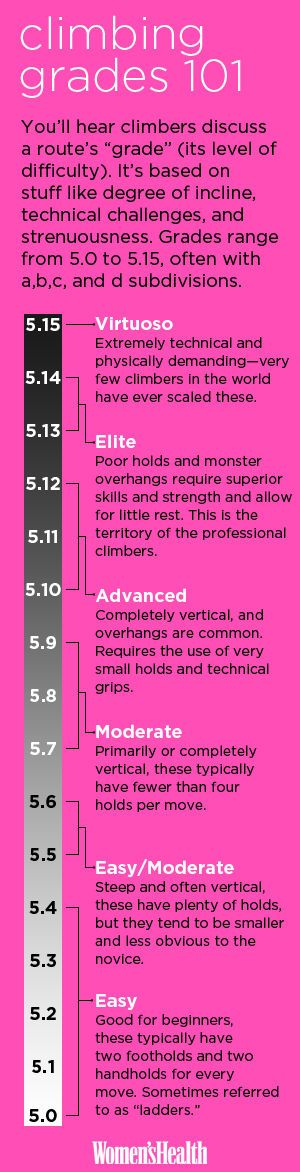
Today, the professional climber has solidified herself as 1 of the biggest names in the sport, female or male. At 18, she took kickoff place overall at the IFSC Climbing Globe Championships and has since get the first adult female to reach the tiptop of Italia'southward nine,754-foot-tall Bellavista Mountain, with its one,200 feet of cliff climbing; she's too the third woman of all time (first and simply from North America)—and the youngest female person ever—to surmount a 5.14d grade climb (see our "Climbing Grades 101" infographic, at right). She's earned sponsorship deals from brands such equally Adidas and Red Balderdash and has more than 45,000 Instagram followers and 94,000 Facebook fans.
"Tackling 'start female' ascents [like Bellavista] isn't just about me," DiGiulian says. "Information technology opens the floodgates to other women's progress. Women climbing strong helps prove to us all that we are more than equal than we may think in climbing—peculiarly on more technical, endurance-oriented routes."
The industry is taking note, catering to women like never before. In Yosemite National Park, for example, the Girls on Granite programme enlists female instructors to teach women of all skill levels how to climb—sometimes even as part of birthday and bachelorette parties. Whereas the sport was once intimidating to nigh mere mortals, today's climbing culture welcomes and inspires women to discover their ain strengths.
Fitter Body, Stronger Mind
Ane picture of DiGiulian'southward trunk could sell more than than a few women on the conditioning. "The physique you get from climbing is...well, it garners quite a few compliments," she says, laughing. "And to climb well, you don't demand to be a manlike man. In fact, beingness light and fit is very practical."
Like a dancer or gymnast, the best climber aims for a high forcefulness-to-body weight ratio. And the workout itself helps develop that: Climbing seamlessly blends cardio and strength grooming into ane session, keeping your heart racing while engaging more musculus than but nigh whatsoever other workout—from your large, calorie-torching muscles, such as glutes and triceps, to your tiny stabilizers. The abiding climbing, pulling, twisting, and pushing helps improve mobility and increment functional fitness (i.e., moving your trunk the fashion it was designed to move); it even boosts grip strength, which is oft disregarded by women but is tightly linked with overall strength and fitness. Oh, and it's also ane of the well-nigh effective and efficient means to strengthen your cadre. "Your core and your hips are essentially what drive your power and provide balance," DiGiulian says. "Your cadre connects your upper- and lower-torso movements, improving your ability to engage while on the wall. Every time you climb, your core gets stronger."

Keith Ladzinski
"Climbing completely changed my body," says Mercedes Pollmeier, fitness director at Vertical World. "I had never felt so strong before. I tin can exercise pullups at present." (Something she couldn't practice even in her days every bit a semipro tennis player!)
Simply the trunk benefits are only half of the draw. Making it upwardly routes—or "issues," as they're referred to in bouldering (see "The New Style," beneath)—involves constant problem solving and mental dexterity. To accomplish that hold, should I raise my foot or swing my body to the right? How can I balance on that overhang? Every piddling move you make could either accelerate your climb or have y'all downwardly the wall. "You learn from declining," says Pollmeier. "Y'all immediately know what you did wrong."
That constant neglect-fall-echo instills a new sense of mental toughness—and focus. When you're balancing 40 feet off the footing and reaching for your next agree, yous can't let your mind wander to your tough day at work or that annoying fight with your pregnant other. "When I'm climbing, I experience like I exist in another realm where everything else fades abroad," DiGiulian says. "I focus on my movements, the rocks, and find my flow."
It'southward a form of agile meditation that few other mind-trunk practices offer. You lot're in tune with your body and mindful of your movements, but you tin't zone out; the heightened mindfulness is what gets you to the top—where you score the biggest benefits. "Making it to the top comes with an unparalleled sense of satisfaction," DiGiulian says. "It's the strongest feeling I've ever felt in my life."
The New Style
A newer climbing style called bouldering is also gaining popularity. Once a training exercise for professional climbers, information technology's now the fastest-growing class of rock climbing. Both at the gym and outside, athletes climb without harness or rope while scaling shorter, 15-pes-tall walls or rocks over cushy crash pads. The comparatively shorter climbs brand it more accessible to those who are intimidated by higher ascents (and falls), and its lower gear threshold makes information technology simpler and less expensive to attempt.
But bouldering'due south accessibility doesn't hateful it'south like shooting fish in a barrel. Without the help of a harness, rope, or partner, climbers (a.one thousand.a. boulderers) rely on their own strength and skills to stay off the crash pad—one reason why climbs typically max out at ii minutes. They move quickly from concur to concord, contorting their bodies in shapes you lot rarely see in traditional climbing. "Bouldering is to sport climbing what sprinting is to marathon running. Information technology'southward a quick, powerful experience," says DiGiulian, who both sport-climbs and boulders. They complement each other: Sport climbing builds endurance and bouldering helps develop ability and speed, according to Mercedes Pollmeier, fitness director at Vertical World.
Get A Grip
Four tips for stronger, faster ascents:
•Apply Your Toes.Brace yourself on footholds using your big toe and forefoot, which are nimble and anatomically designed to help manage your weight distribution.
•Hug The Wall.Proceed your hips close to the wall (read: don't stick your butt out). It positions your center of gravity above your anxiety to prevent falls and take stress off of your arms.
• Button Off.Initiate moves from your legs. Climbers who mainly pull with their artillery (a mutual rookie movement) fatigue faster, no matter how strong they are.
•Be Creative.Women tend to be flexible and accept solid balance, helping them reach different (but oftentimes more efficient) footholds than male person climbers.
More than from Women'southward Wellness:
RUN ten FEED 10
vi Means to Forcefulness Train Outdoors
What 3 Female UFC Fighters Think Almost Throwing Punches and Kicking Butt
This content is created and maintained by a third political party, and imported onto this page to aid users provide their email addresses. You may be able to find more than information about this and like content at piano.io
Source: https://www.womenshealthmag.com/fitness/a19941443/rock-climbing/

Post a Comment for "what caused the hard rock hotel to collapse"